
Memory
Milogs: Memory Journal App With Long-Term Recall
Milogs is a memory journal app built for long-term recall. Keep the moments that matter with the photos, voice notes, and links that give them context, then find them years later through tags, full-text search, and a daily timeline that keeps every memory anchored to its date.
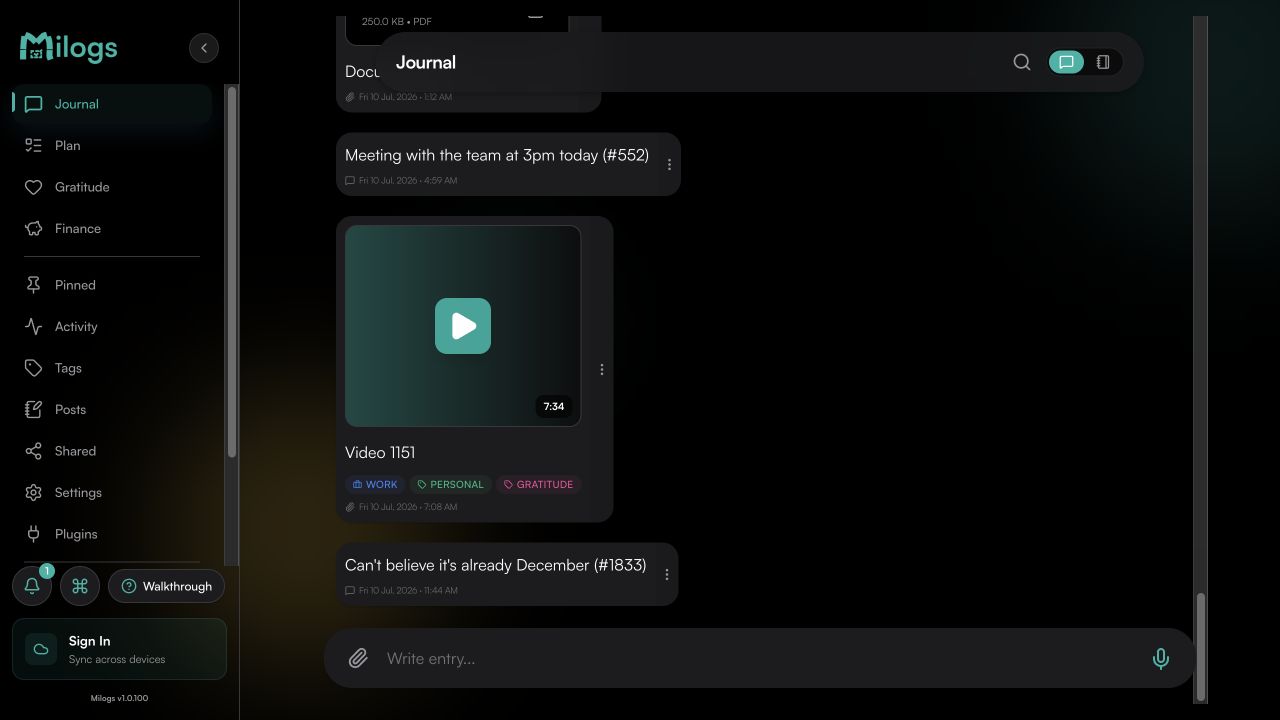
Recall is the hard part
Writing a memory down is easy. Finding it six years later is not. Tags, full-text search, and a daily timeline turn a pile of entries into something you can actually look things up in.
Context travels with the moment
A memory entry keeps the photograph, the voice note, the saved link, and the sentence you wrote together, so the entry still makes sense after you have forgotten the surrounding week.
Built to outlast the year you wrote it
A memory archive is a decades-long commitment, so Milogs is local-first with no ads, no telemetry, and no data sales. When you sync, it is end-to-end encrypted.
What you can do
A clear answer
What is this for?
A memory journal is a record you expect to reread in ten years, which changes what it needs. Most apps optimise for the moment of capture and leave you with an unsorted archive. Milogs optimises for the return trip: date, tags, and full-text search over entries that carry their photos, voice notes, and links with them.
1. Record it in place
Capture the moment while it is still warm: a photograph, a voice note, a link, and one line explaining why you are keeping it.
2. Give it a way back
Tag the entry with the person, place, or recurring theme it belongs to. Spoken memories are transcribed on your device, so the words inside them become searchable.
3. Find it years later
Search a phrase, follow a tag, or open the timeline on a date you half remember. Pinned memories stay within reach for the moments you return to often.
Frequently asked questions
Why does long-term recall matter more than quick capture?
Capture takes seconds; recall is what you are actually buying. An entry you cannot find in five years is a memory you have effectively lost. Milogs treats retrieval as a first-class feature, which is why every memory carries a date in the daily timeline and responds to tags and full-text search.
How do I find a memory I wrote years ago?
Search for a word or phrase you remember using, or follow a tag for a person, place, or theme. If you only remember roughly when it happened, open the daily timeline and browse to the date. Spoken entries are transcribed on your device, so their words are searchable too.
Can a memory hold more than text?
Yes. A memory entry holds photos, voice notes, links, and files alongside your words, in the same record. That matters more than it sounds: a photograph without your sentence about it, or a sentence without the photograph, is half a memory.
Is my memory archive private when it syncs across devices?
Yes. Milogs is local-first, so your memories live on your device and work offline. When you enable optional sync, your entries and their media are end-to-end encrypted. There are no ads, no telemetry, and no data sales.